
AI SEO Explained: What AEO, GEO, and LLMO Mean for Your Business in 2026
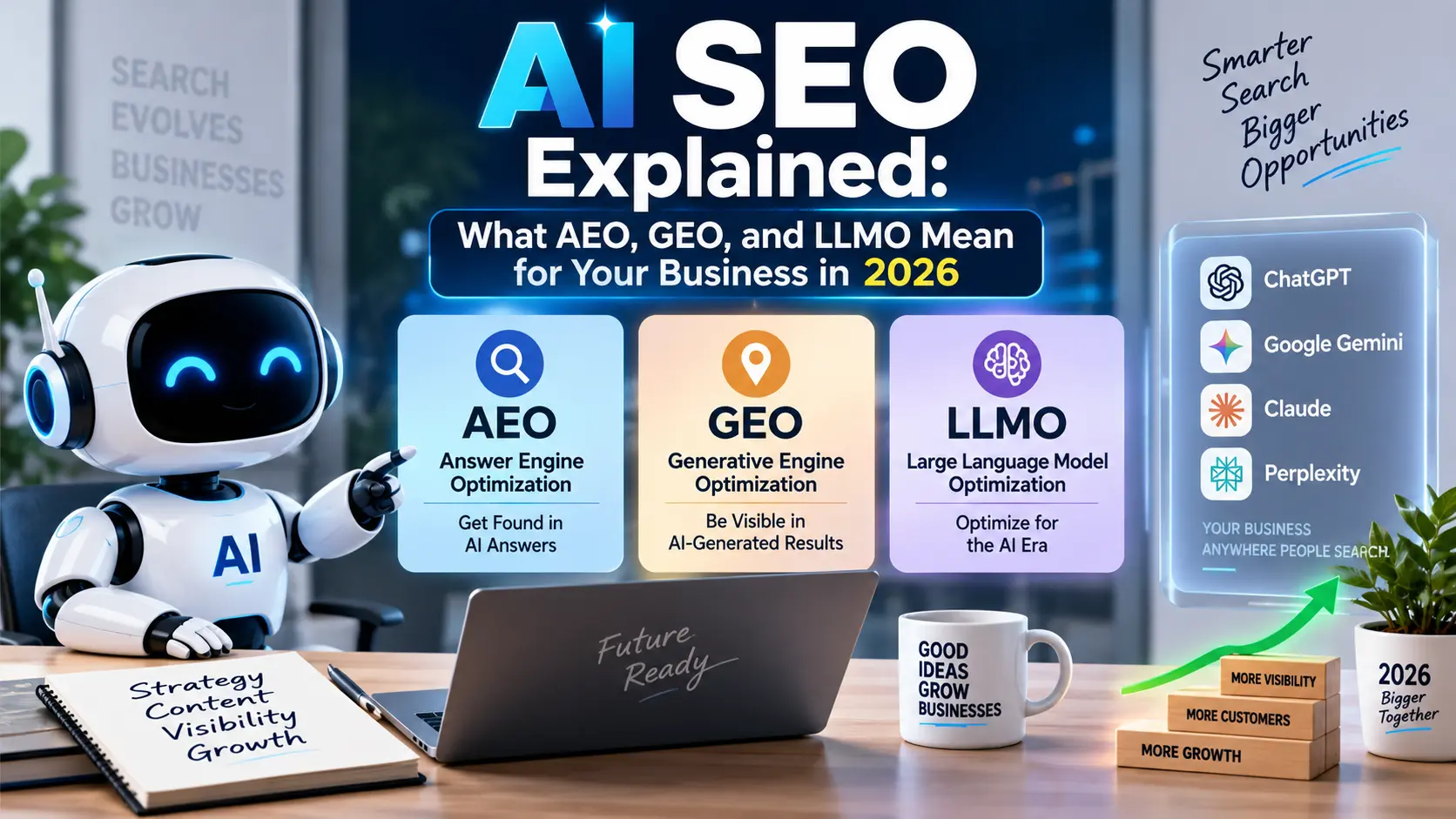
Search has split into two paths. People still type into Google, but they also ask ChatGPT, Perplexity, and Google’s AI Overviews for answers. If your business is only built for the old kind of search, you are invisible on the new one.
This guide breaks down what AI SEO actually means, what AEO, GEO, and LLMO stand for, and how a business in Dehradun, Uttarakhand, or anywhere in India can start using them. No jargon for the sake of jargon, just what each term means and why it matters.
What Is AI SEO?
AI SEO is the practice of optimizing a website and its content so it shows up in two places at once: traditional Google search results, and AI-generated answers from tools like ChatGPT, Gemini, Perplexity, and Google AI Overviews.
Traditional SEO asks: “Will Google rank this page for this keyword?”
AI SEO asks a second question: “Will an AI tool read this page and recommend it as part of an answer?”
Both questions matter now. Ignoring the second one means losing visibility with a growing number of searchers who never open a traditional search engine at all.
AEO: Answer Engine Optimization
AEO means structuring your content to directly answer specific questions, the way a person would ask them out loud.
Instead of writing a vague paragraph about “our services,” AEO content answers exact questions: “How much does SEO cost in Dehradun?” or “How long does local SEO take to show results?”
This matters because Google’s featured snippets, People Also Ask boxes, and voice search results all pull from content that answers a question clearly and directly, usually in the first sentence or two of a section.
Simple way to apply this: Turn your website headings into real questions your customers actually ask, then answer them in plain language right underneath.
GEO: Generative Engine Optimization
GEO is about getting your business mentioned inside AI-generated answers, not just ranked on a search results page.
When someone asks ChatGPT or Google AI Overviews “best cafe in Dehradun” or “reliable SEO consultant near me,” the AI tool pulls information from multiple sources, including websites, Reddit threads, review platforms, and business directories, then generates a single answer.
GEO means making sure your business information is clear, consistent, and present across those sources, not just buried inside your own website.
Simple way to apply this: Keep your business name, description, and services consistent across your website, Google Business Profile, and any directory listing. AI tools cross-reference these sources, and inconsistency makes them less likely to trust or mention you.
LLMO: Large Language Model Optimization
LLMO focuses on writing content in a way that large language models like GPT-4 or Gemini can easily understand, extract, and cite.
AI models work best with clear, structured, fact-based writing, short paragraphs, direct statements, and content organized under specific headings. Vague marketing language and keyword-stuffed sentences are harder for these models to use as a source.
Simple way to apply this: Write the way you would explain something to a smart friend, not the way you would write an ad. Structured data (schema markup) also helps here, since it gives AI tools clean, labeled information to work with.
Traditional SEO vs AI SEO: What Actually Changes
| Area | Traditional SEO | AI SEO |
|---|---|---|
| Goal | Rank on Google’s results page | Rank on Google, and get cited by AI tools |
| Content style | Keyword-focused | Question and answer focused |
| Where it’s read | Mainly your own website | Your website, directories, reviews, forums |
| Success measure | Search rankings | Rankings plus AI mentions and citations |
| Timeline | Usually 3 to 6 months | Similar timeline, but early movers get an edge |
Traditional SEO is not being replaced. AI SEO is an additional layer built on top of it. A weak, thin website will not suddenly perform well just because it adds AI-friendly formatting. The technical and content fundamentals still come first.
How to Actually Start With AI SEO
- Fix the basics first. Broken pages, slow load times, and missing content will hold back both Google rankings and AI visibility. There is no shortcut around this step.
- Answer real questions on your website. Look at what customers actually ask you in person or over the phone, and turn those into clear headings with direct answers on your site.
- Keep your business information consistent everywhere. Your Google Business Profile, website, and any directory listing should say the same thing about what you do and where you’re located.
- Add structured data (schema). This gives search engines and AI tools a clean, labeled version of your information to pull from, rather than making them guess from plain text.
- Track more than rankings. Check if your business shows up when you personally ask ChatGPT or Perplexity a relevant question. This is the simplest way to see if your AI SEO work is actually landing.
A Real Example, Not a Theoretical One
One client I work with, a small cafe in Dehradun, saw a real jump in Google Business Profile activity after cleaning up their business information and optimizing for the exact questions customers were searching, alongside consistent local SEO work. Bookings and profile views moved up within a single month.
That result did not come from a trick or a shortcut. It came from getting the basics right and layering AI-aware optimization on top, which is the same process behind AI SEO for any business, in any city.
Frequently Asked Questions
What is the difference between AI SEO and traditional SEO? Traditional SEO focuses on ranking in Google’s search results. AI SEO adds a second layer: making sure AI tools like ChatGPT and Google AI Overviews can read, understand, and recommend your business too. Both work together rather than replacing each other.
Do AEO, GEO, and LLMO require separate strategies? No. They overlap significantly. Clear, question-based content with consistent business information across the web supports all three at once. Most small businesses do not need to treat them as separate projects.
How long does AI SEO take to show results? Similar to traditional SEO, most businesses see measurable movement within 6 to 10 weeks, with stronger results building over 3 to 6 months. Businesses that already have strong technical SEO tend to see AI search visibility improve faster.
Is AI SEO only useful for large businesses? No. Local businesses often benefit the most, since AI tools are increasingly used for local, specific queries like “best clinic near me” or “affordable cafe in Dehradun.” A clear, well-structured local presence can compete well against larger, less focused competitors.
Can I do AI SEO myself, or do I need an expert? The basics, consistent business information and clear content, can be done by any business owner. Technical elements like schema markup and structured audits usually benefit from working with someone who does this regularly, since small technical mistakes can undo the work.
If you want a clear look at where your own website and Google Business Profile currently stand for AI search, I offer a free audit for businesses in Dehradun and across Uttarakhand. See real results and get in touch here.